h1

Give me a P! No, on second thoughts, don’t.

November 26, 2012

Another quick one today, as both my hands and throat have been extremely painful over the weekend. This, however, gives me today’s topic – Substance P.

Substance P (Image created by wikipedia user  Fvasconcellos)

Substance P (Image created by wikipedia user Fvasconcellos)

Substance P is a neuropeptide that most people have never heard of that transmits pain and inflammation information from the sensory nerves to the spinal nerves(mainly).
The problem is, in some conditions, the levels of substance P appear to be much higher than they should be for the pain causing stimulus. The reason for this is not very well understood, but it is known that medications which affect the neurotransmitter glutamate, which coexists with substance P, can help reduce the level of pain in some of those conditions.
The other substance that can affect it is capsaicin – the “hot” (it actually works as a cell irritant to create that feeling) component of chillis. This is why a number of treatments for conditions like arthritis use capsaicin in a gel form to “recalibrate” the sensory nerves to transmit less substance P.

h1

It came from Mars!

November 21, 2012

I thought I’d join in the science bloggers sense of anticipation at what the Curiosity Rover has found on Mars. For those who don’t know, John Grotzinger, who is in charge of the rover’s investigations, told the US’s National Public Radio that what they had found was “gonna be one for the history books“.

Sample Analysis at Mars Laboratory
When hearing which instruments on the rover produced the data – the Sample Analysis at Mars(SAM), which is virtually a complete portable physical chemistry lab – and along with the above quote, most commentators have come to the conclusion that they have found organic compounds, which are, of course, the building blocks of life as we know it.
Previous landers sent to Mars to look for organic compounds have come up empty, which is thought to be due to the presence of perchlorates in the Martian soil which may have confused the instruments in those missions.
Organic molecules on their own do not necessarily mean life, and there is a fair amount of them wandering around in space. What we can hope for is a slightly more complex organic compound, such as an amino acid.
We shall (hopefully) all find out at the American Geophysical Union’s Fall Meeting on the 3–7 December, where the results will be presented.

h1

Musical brains

November 19, 2012

I found this bit of research quite interesting for a couple of reasons. Firstly, I’ve always been interested in how the brain performs certain tasks, being a neuroscience bod. Secondly, my partner is a freestyle lyricist (although she’s not a rapper), and being of a more traditional singing persuasion myself, I’ve always wondered how she did it so easily.
Now I know, and it’s beautifully simple – she switches off the parts of her brain that limit creativity into a sensible and manageable flow. This allows the brain to increase bloodflow into the thought and language areas themselves, and thus allowing words to travel out straight from there, rather than being constrained in the same way they would be normally.
In fact, in the case of singing freestyle lyricists, there would be one more stage. As well as following a rhythm, they also have to follow the music, and either sing along with it, or harmonize with any existing singing.
I have heard my partner perform some very complex harmonies without having heard the track she was freestyling over. This means that some of the supervisory areas of her brain were still in play, to allow her to improvise in such a way.
The human brain is a wonderful thing.
The paper is here.

h1

That’s no moon – that’s a wandering planet!

November 14, 2012

In a late, but short post – astronomers have just found a planet having a bit of a wander away from any star system. This is important, as it reinforces the idea that there are quite a few “rogue” planets (although not as many rouge planets, as I originally spelled it) tootling along in the inter-system space of galaxies.
The big ones, are thought to coalesce in the same way solar systems do, but there are smaller ones that are ejected from their parent stars for a number of reasons from unstable orbits to collisions. As this one is 4-7 times the size of Jupiter, it could fall into either camp.
This one is only 100 light years away, which is “just ’round the corner” in astronomical terms, and quite young (20-200 million years) and warm(~700K or around 400+ degrees celcius), which tells you how much can be ascertained and derived from astronomical spectrography and mathematical modelling.
The paper can be found here.

h1

Where art, neurons and fractals collide.

November 12, 2012

One of the things I have always appreciated in its many forms is pictorial art. As the use of my hands has reduced, I’ve been able to produce an awful lot less of it, but my appreciation of other people’s art has not changed.

This gallery of images(go through the slideshow) is a case in point. Dunn noticed the similarity between blowing ink across paper and neuron form. He is a neuroscientist, so the comparison would be foremost in his mind, and the art he has produced is striking both aesthically and in familiarity.

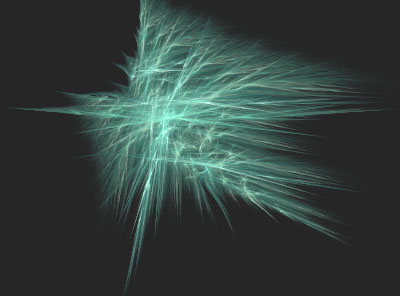
I, being a mathematician who has done a fair amount of neuronal modelling, see neuronal forms when playing around with other mathematical tools. Take for example this simple fractal flame I made with Apophysis:

Neuron Flame

It is simple to see the somas and dendrites within this fractal. There is a reason for this. Neuron growth can be described in fractal terms. There is a touch of pareidolia to seeing things in such fractals as that flame, and a lot of people see fractals in virtually everything living, but that paper shows that neuronal growth can be modelled quite closely using fractal techniques.

h1

I appear to be tied up with Markov Chains

November 9, 2012

I’ve been thinking recently about a simple way of coming up with character names for fiction, as you do. There is a tried and tested way of doing this using mathematics (well, statistics) called Markov Chains.
— Start Rant —
The trouble is, as for so many things involving mathematics, that the formal definition (as you can see in the wikipedia link above) is far too complicated for people who are simply interested in the topic as opposed to mathematicians. I understand that mathematics needs complete ways of describing things, and, as an erstwhile mathematician myself, such definitions are useful for those who need to implement them. However, I feel that seeing complicated equations for such a (comparatively) simple system will put off the non-mathematician who has heard of the subject and wants to know more.
It’s like dropping someone who has heard that swimming is interesting directly into the deep end, and then telling them as they pull their exhausted and sodden body out that it was their own fault that they nearly drowned for not knowing more about swimming, and that it’s not the swimming instructor’s fault that they were told that this was an “Introduction to Swimming” class.
In this case (and a lot of the mathematical articles on wikipedia – this one is better than most), mathematical language and equations in university level notation are used to keep the non-mathematically inclined out, albeit (hopefully) unintentionally. Mathematics are the corner stone of all scientific knowledge, and should be free for everyone to understand, when expressed in a manner that would allow the greatest number of people to appreciate.
— End Rant —

Now, where was I? Markov Chains.
Simply put, they’re a system of working out what’s going to to occur next in a set of values, given the current value. You look at past values, and see what happened the last few times this value came up, and work out what is likely to come next.
This is good for coming up with names. You feed the system a whole set of names like the one you want, i.e. for a male name you process a set of male names. It then cuts up the names into a set of letters (either by themselves or grouped into two or more letters next to each other), and sees what letters usually come after that letter. You can then create a new name by randomly selecting a start letter, then choosing the next letter based on the information you’ve generated, over and over again until you come up with a name.
The one thing to remember is that Markov chains have no memory, as such. The previous letter you generate isn’t factored into the processing of the current letter. This makes it useful for statistically predicting things that share that property.
This entry was done in a few sessions, as I didn’t expect it to be this long! I hope it’s found interesting.

h1

Now that’s a self portrait

November 7, 2012

I know I’m a bit late to the party, but here’s a beautiful self portrait of the Mars Curiosity Rover taken on the surface of Mars.

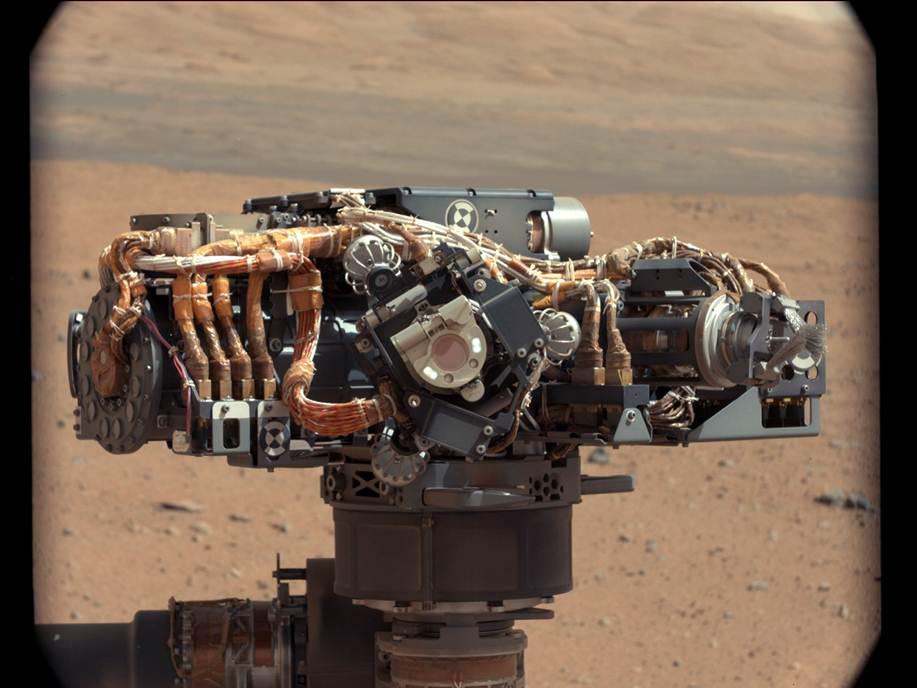
It’s almost like NASA are baiting the conspiracy theorists now. It is, of course, a combination of a number of photographs taken by the Mars Hand Lens Imager(MAHLI). This camera is stuck on a robot arm that lets it have a good look at any rocks NASA’s interested in. The picture below shows it on its arm:

MAHLI

Definitely getting a Johnny Five vibe off that thing.
Emily Lakdawalla of the Planetary Society has a picture of all the sub-photos it took to make the image here.

h1

Spinal nerve regeneration gene found

November 5, 2012

In a press release Thursday, a rather important bit of research from Penn State’s Biochemistry and Molecular Biology department was described. This hasn’t been picked up by that many big news organizations though. In short, they’ve worked out which gene is turned off to stop nerves from regrowing themselves. It may seem a bit weird that they would look for such a gene, so a bit of background is required.
There are two types of nerves when it comes to nerve regeneration. Peripheral nerves and Central Nervous System (CNS) nerves. Simply put, peripheral nerves are the ones that go to the limbs and body, and the CNS nerves are the nerves in the brain and spinal cord.
Peripheral nerves tend to regenerate quite happily (albeit slowly, and often with reduced sensation), especially when given a little help from a passing surgeon.
CNS nerves are a different kettle of fish. When severed, they unfortunately tend to stay that way for a number of reasons. In the case of spinal cord injury, the inflammatory response, which is supposed to help, damages the nerve cells so they can’t regenerate. That’s why these days people are given an anti-inflammatory steroid as soon as they get to hospital and are kept on it for up to 48 hours. Unfortunately that often isn’t enough, as there are a number of other factors involved. This has led to research into repairing or bridging damaged nerves, from using stem cells to electrical stimulation below the damage.
This new research is quite exciting inasmuch as it helps us to understand what is actually going on with nerve regeneration. This could open the door to huge amounts of new research using the method described of controlling cell regeneration, which in turn could hopefully lead to treatments both for genetic spinal cord syndromes and spinal cord injury.
The paper is here.(Abstract, requires Cell subscription – which I don’t have either – for full text)

h1

Of Sponges, Carpets and Blog Headers

November 2, 2012

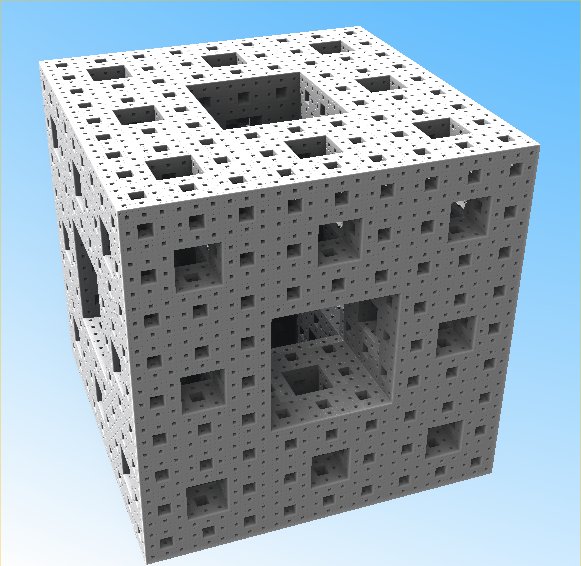
I thought I’d start with explaining what the header image to my blog actually is. It is a zoomed in image of a type of fractal called a Menger Sponge, generated by an excellent program called Mandelbulber and smoothed a little in Photoshop.
I shall leave an explanation of what a fractal actually is until a later post, except to say that generally they’re mathematical sets that tend to stay just as complex the closer you look at at a representation of them. Also they had a tendency to make an appearance on techno and dance music CD sleeves in the mid to late 90s. Of course this is a massive simplification of what they are, but I’m trying to keep the tone of this blog somewhere between pop-science and wading through obscure corners of the literature.
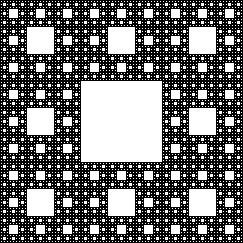
The Menger Sponge is a three dimensional version of the more commonly seen Sierpinski Carpet. As for the names, it’s easy to see that they follow the trend of <Discoverer’s Name> <Something everyone has heard of>. Looking at a Sierpinski carpet makes its name quite sensible.

Sierpinski Carpet
It is calculated in a very simple manner. You start with a square, and divide it into 3 parts on each side, making 9 squares. You then cut out the square in the middle. The fun bit comes next. You then take all the squares that are still there, and do the same to them as you did to the original square. You can then repeat this to make smaller and small features forever, or until you get bored, whichever comes first.
A Menger Sponge takes this idea, but starts with a cube, and each side of the cube is treated in the same way as for the Sierpinski carpet, but the whole goes all the way through the cube, making lots of sub-cubes, which you do the same to. After a few hundred repetitions of this you end up with something like this:

Menger Sponge

Which you then colour in, smooth a bit and set at the top your blog with some writing on!

h1

Welcome to the Land of Gregs

November 1, 2012

Hello all.

This blog is where I shall be sharing my musings on science and probably everything else, as well as sharing any science/mathematical news I find interesting.

Who is Gregs? I am a disabled man in his late thirties who has done a few things in the scientific/engineering/mathematical/biomedical fields, but now must spend most of his time observing. I have difficulty typing a lot of the time these days, so a lot of this blog will be done using speech recognition software, which should be amusing, if I miss any mistakes.

As for mistakes, please feel free to correct me if I make any scientific errors. Nobody’s perfect, and me least of all.

I may drift into personal opinion on world events from time to time, plus the odd literary/music reference so this isn’t a strictly science blog, but hopefully it’ll be entertaining! That and I have to keep up my appearance as a Renaissance man, after all:)