Archive for the ‘Neuroscience’ Category

h1

TED talks in his sleep

December 7, 2012

You may have heard of TED talks. They are a really good platform for scientists and other specialists to put over their research, especially if it’s groundbreaking. It proved so popular that TED branched out to regional talks, put on around the world and hosted by local institutions, who were given the ability to book the best and brightest in their fields from their local area, under the banner of TEDx. This is where things started falling apart.
Once the vetting was out of the primary organizer’s hands, pseudoscience started creeping in, and it became so bad that people started complaining. I would love to give examples, but unfortunately, I live in the UK and our libel laws tend to beggar people, even if they’re proved right. The majority of the talks were still massively informative, such as Sir Roger Penrose’s cosmology talk (and this talk by my old boss) at TEDxWarwick, but the situation became so bad, that the people at TED have had to produce some new guidelines.
“Excellent!” I hear you cry, and I agreed until I got to this line, about things to watch out for: “The neuroscience of [fill in the blank]”, at which point I became filled with righteous indignation, being a neuroscience bod myself(albeit a mathematical one). Then I typed “The neuroscience of” into Google. By a few pages in, I found myself in complete agreement with the new guidelines. Neuroscience explains a lot of things about physiological responses, but the level of extrapolation required for some of those results, along with a truckload of cognitive dissonance, did wonders for worsening my migraine.
Hopefully this will bring a new era for TEDx talks that echoes the joy of discovery that came with the original launch of TED.

Thanks to Ben Goldacre’s Twitter feed for this news.

h1

Give me a P! No, on second thoughts, don’t.

November 26, 2012

Another quick one today, as both my hands and throat have been extremely painful over the weekend. This, however, gives me today’s topic – Substance P.

Substance P (Image created by wikipedia user  Fvasconcellos)

Substance P (Image created by wikipedia user Fvasconcellos)

Substance P is a neuropeptide that most people have never heard of that transmits pain and inflammation information from the sensory nerves to the spinal nerves(mainly).
The problem is, in some conditions, the levels of substance P appear to be much higher than they should be for the pain causing stimulus. The reason for this is not very well understood, but it is known that medications which affect the neurotransmitter glutamate, which coexists with substance P, can help reduce the level of pain in some of those conditions.
The other substance that can affect it is capsaicin – the “hot” (it actually works as a cell irritant to create that feeling) component of chillis. This is why a number of treatments for conditions like arthritis use capsaicin in a gel form to “recalibrate” the sensory nerves to transmit less substance P.

h1

Musical brains

November 19, 2012

I found this bit of research quite interesting for a couple of reasons. Firstly, I’ve always been interested in how the brain performs certain tasks, being a neuroscience bod. Secondly, my partner is a freestyle lyricist (although she’s not a rapper), and being of a more traditional singing persuasion myself, I’ve always wondered how she did it so easily.
Now I know, and it’s beautifully simple – she switches off the parts of her brain that limit creativity into a sensible and manageable flow. This allows the brain to increase bloodflow into the thought and language areas themselves, and thus allowing words to travel out straight from there, rather than being constrained in the same way they would be normally.
In fact, in the case of singing freestyle lyricists, there would be one more stage. As well as following a rhythm, they also have to follow the music, and either sing along with it, or harmonize with any existing singing.
I have heard my partner perform some very complex harmonies without having heard the track she was freestyling over. This means that some of the supervisory areas of her brain were still in play, to allow her to improvise in such a way.
The human brain is a wonderful thing.
The paper is here.

h1

Where art, neurons and fractals collide.

November 12, 2012

One of the things I have always appreciated in its many forms is pictorial art. As the use of my hands has reduced, I’ve been able to produce an awful lot less of it, but my appreciation of other people’s art has not changed.

This gallery of images(go through the slideshow) is a case in point. Dunn noticed the similarity between blowing ink across paper and neuron form. He is a neuroscientist, so the comparison would be foremost in his mind, and the art he has produced is striking both aesthically and in familiarity.

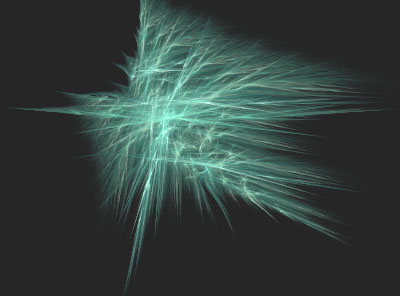
I, being a mathematician who has done a fair amount of neuronal modelling, see neuronal forms when playing around with other mathematical tools. Take for example this simple fractal flame I made with Apophysis:

Neuron Flame

It is simple to see the somas and dendrites within this fractal. There is a reason for this. Neuron growth can be described in fractal terms. There is a touch of pareidolia to seeing things in such fractals as that flame, and a lot of people see fractals in virtually everything living, but that paper shows that neuronal growth can be modelled quite closely using fractal techniques.

h1

Spinal nerve regeneration gene found

November 5, 2012

In a press release Thursday, a rather important bit of research from Penn State’s Biochemistry and Molecular Biology department was described. This hasn’t been picked up by that many big news organizations though. In short, they’ve worked out which gene is turned off to stop nerves from regrowing themselves. It may seem a bit weird that they would look for such a gene, so a bit of background is required.
There are two types of nerves when it comes to nerve regeneration. Peripheral nerves and Central Nervous System (CNS) nerves. Simply put, peripheral nerves are the ones that go to the limbs and body, and the CNS nerves are the nerves in the brain and spinal cord.
Peripheral nerves tend to regenerate quite happily (albeit slowly, and often with reduced sensation), especially when given a little help from a passing surgeon.
CNS nerves are a different kettle of fish. When severed, they unfortunately tend to stay that way for a number of reasons. In the case of spinal cord injury, the inflammatory response, which is supposed to help, damages the nerve cells so they can’t regenerate. That’s why these days people are given an anti-inflammatory steroid as soon as they get to hospital and are kept on it for up to 48 hours. Unfortunately that often isn’t enough, as there are a number of other factors involved. This has led to research into repairing or bridging damaged nerves, from using stem cells to electrical stimulation below the damage.
This new research is quite exciting inasmuch as it helps us to understand what is actually going on with nerve regeneration. This could open the door to huge amounts of new research using the method described of controlling cell regeneration, which in turn could hopefully lead to treatments both for genetic spinal cord syndromes and spinal cord injury.
The paper is here.(Abstract, requires Cell subscription – which I don’t have either – for full text)