This is just a quick entry to explain why I haven’t been blogging recently. The simplest explanation is that I had a chest cold. I have a number of conditions that make this rather more serious than for healthy people, but that’s no excuse for not blogging! The real reason is that I use speech recognition when I can’t use my hands. As you can imagine, given the current state of speech recognition, a chest cold is not a good thing for getting a computer to understand you. In fact:
“It can imagine giving them a better holding more than they are getting your computer to the new room and”
was the output of my computer’s speech recognition to the previous sentence with my cold.
Speech recognition typically uses a form of a mathematical model that I have discussed before – the Markov model. In fact it uses a more complicated version of it called a Hidden Markov Model or HMM. This uses a set of Markov nodes(states that have a probability of linked to other states) that are not connected to the input or output (and so are called hidden) to allow the model to have a form of “memory” that simple Markov chains don’t. Thus, they can be used to recognize what is likely to come next while the input is streaming in, and so recognize speech. The trouble is, if the input is really different to what it’s used to, it messes up the probabilities, and you get a sentence a bit like the one above.
Hopefully normal service will resume shortly when either my voice or my hands are more usable. Without voice recognition, even this short entry took a few sessions to complete
Archive for the ‘Mathematics’ Category

Now they’re hiding the Markov Chains!
December 13, 2012Where art, neurons and fractals collide.
November 12, 2012One of the things I have always appreciated in its many forms is pictorial art. As the use of my hands has reduced, I’ve been able to produce an awful lot less of it, but my appreciation of other people’s art has not changed.
This gallery of images(go through the slideshow) is a case in point. Dunn noticed the similarity between blowing ink across paper and neuron form. He is a neuroscientist, so the comparison would be foremost in his mind, and the art he has produced is striking both aesthically and in familiarity.
I, being a mathematician who has done a fair amount of neuronal modelling, see neuronal forms when playing around with other mathematical tools. Take for example this simple fractal flame I made with Apophysis:
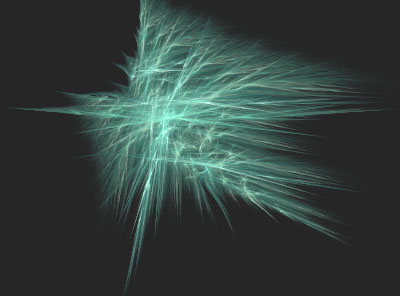
It is simple to see the somas and dendrites within this fractal. There is a reason for this. Neuron growth can be described in fractal terms. There is a touch of pareidolia to seeing things in such fractals as that flame, and a lot of people see fractals in virtually everything living, but that paper shows that neuronal growth can be modelled quite closely using fractal techniques.
I appear to be tied up with Markov Chains
November 9, 2012I’ve been thinking recently about a simple way of coming up with character names for fiction, as you do. There is a tried and tested way of doing this using mathematics (well, statistics) called Markov Chains.
— Start Rant —
The trouble is, as for so many things involving mathematics, that the formal definition (as you can see in the wikipedia link above) is far too complicated for people who are simply interested in the topic as opposed to mathematicians. I understand that mathematics needs complete ways of describing things, and, as an erstwhile mathematician myself, such definitions are useful for those who need to implement them. However, I feel that seeing complicated equations for such a (comparatively) simple system will put off the non-mathematician who has heard of the subject and wants to know more.
It’s like dropping someone who has heard that swimming is interesting directly into the deep end, and then telling them as they pull their exhausted and sodden body out that it was their own fault that they nearly drowned for not knowing more about swimming, and that it’s not the swimming instructor’s fault that they were told that this was an “Introduction to Swimming” class.
In this case (and a lot of the mathematical articles on wikipedia – this one is better than most), mathematical language and equations in university level notation are used to keep the non-mathematically inclined out, albeit (hopefully) unintentionally. Mathematics are the corner stone of all scientific knowledge, and should be free for everyone to understand, when expressed in a manner that would allow the greatest number of people to appreciate.
— End Rant —
Now, where was I? Markov Chains.
Simply put, they’re a system of working out what’s going to to occur next in a set of values, given the current value. You look at past values, and see what happened the last few times this value came up, and work out what is likely to come next.
This is good for coming up with names. You feed the system a whole set of names like the one you want, i.e. for a male name you process a set of male names. It then cuts up the names into a set of letters (either by themselves or grouped into two or more letters next to each other), and sees what letters usually come after that letter. You can then create a new name by randomly selecting a start letter, then choosing the next letter based on the information you’ve generated, over and over again until you come up with a name.
The one thing to remember is that Markov chains have no memory, as such. The previous letter you generate isn’t factored into the processing of the current letter. This makes it useful for statistically predicting things that share that property.
This entry was done in a few sessions, as I didn’t expect it to be this long! I hope it’s found interesting.
Of Sponges, Carpets and Blog Headers
November 2, 2012I thought I’d start with explaining what the header image to my blog actually is. It is a zoomed in image of a type of fractal called a Menger Sponge, generated by an excellent program called Mandelbulber and smoothed a little in Photoshop.
I shall leave an explanation of what a fractal actually is until a later post, except to say that generally they’re mathematical sets that tend to stay just as complex the closer you look at at a representation of them. Also they had a tendency to make an appearance on techno and dance music CD sleeves in the mid to late 90s. Of course this is a massive simplification of what they are, but I’m trying to keep the tone of this blog somewhere between pop-science and wading through obscure corners of the literature.
The Menger Sponge is a three dimensional version of the more commonly seen Sierpinski Carpet. As for the names, it’s easy to see that they follow the trend of <Discoverer’s Name> <Something everyone has heard of>. Looking at a Sierpinski carpet makes its name quite sensible.
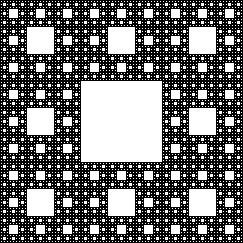
It is calculated in a very simple manner. You start with a square, and divide it into 3 parts on each side, making 9 squares. You then cut out the square in the middle. The fun bit comes next. You then take all the squares that are still there, and do the same to them as you did to the original square. You can then repeat this to make smaller and small features forever, or until you get bored, whichever comes first.
A Menger Sponge takes this idea, but starts with a cube, and each side of the cube is treated in the same way as for the Sierpinski carpet, but the whole goes all the way through the cube, making lots of sub-cubes, which you do the same to. After a few hundred repetitions of this you end up with something like this:
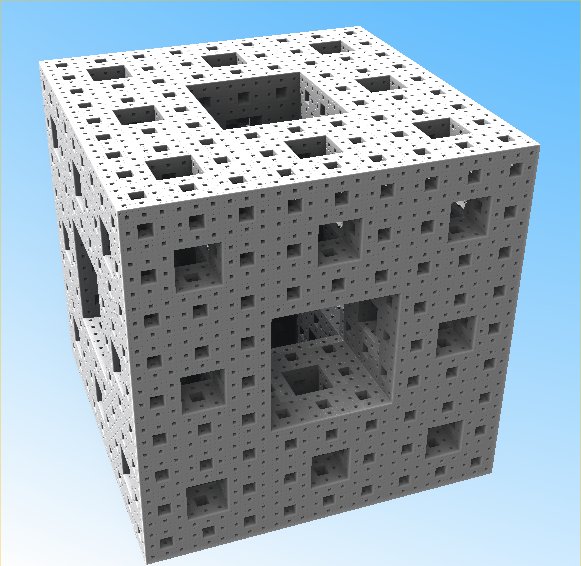
Which you then colour in, smooth a bit and set at the top your blog with some writing on!
 Land of Gregs